
Study permits nearly doubled to over 1 million by 2023, then fell 43% under new caps. We break down what drove the surge, the reversal, and what's next.

Between 2019 and 2023, Canada transformed itself into one of the world's top destinations for international students and temporary workers alike. Study permit holders nearly doubled — from 638,300 to over one million. Work permit holders more than doubled — from 697,000 to 1.58 million. Then, with little warning, the Canadian government pulled the brakes. By 2025, new study permit approvals had fallen 43% from their 2023 peak. Work permit numbers showed their first year-on-year decline in half a decade. This is the story behind the numbers — what drove the surge, what triggered the reversal, and what it means for anyone considering Canada in 2026.
A Decade in One Chart: Study Permit Holders, 2019–2024
Canada began the decade as a popular but manageable study destination. In December 2019, exactly 638,300 international students held valid study permits. Then came COVID-19. Border closures caused a rare contraction: the year-end total fell to 528,200 in 2020, a 17% drop. The rebound, however, was explosive. As Canada rapidly reopened its borders and resumed in-person learning, study permit holders climbed to 621,600 in 2021, surged to an estimated 807,750 in 2022, and broke one million for the first time in 2023 — reaching 1,040,985. That single year represented a staggering 63% increase over the pre-pandemic baseline.
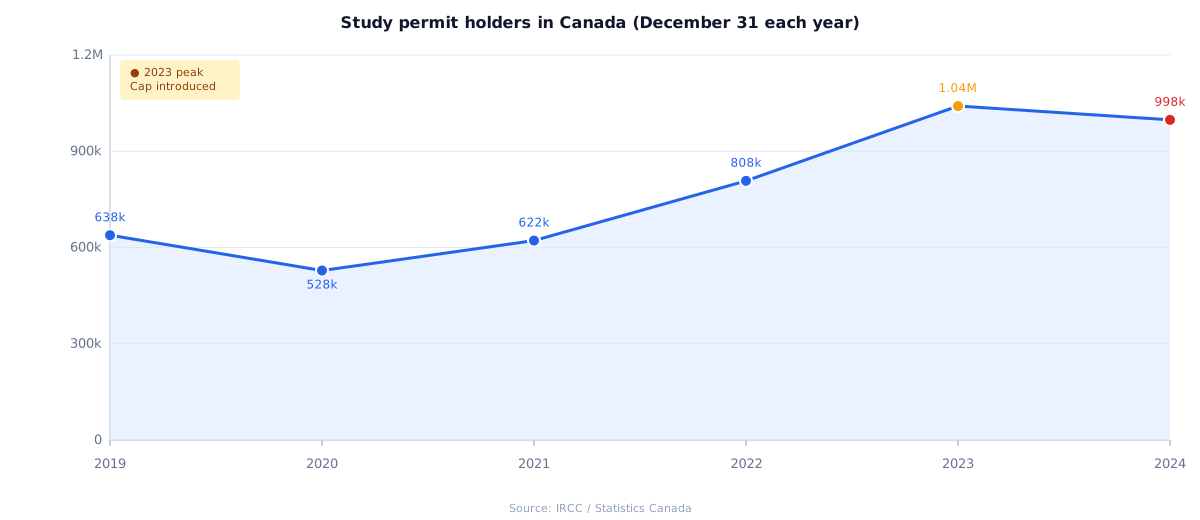
The 2024 data marks a turning point. For the first time in the post-COVID era, the total number of active study permit holders declined — from 1,040,985 to 997,820. While a 4% dip may seem modest, it signals a structural policy shift, not a temporary fluctuation.
New Permits Issued: A Record Broken, Then a Policy Reversal
The surge in total holders was driven by an equally dramatic rise in new permits being approved each year. Approvals climbed from roughly 250,000 in 2020 to a record 680,795 in 2023 — a 172% increase in three years. In January 2024, the federal government announced a two-year cap, initially set at 360,000 new study permits for calendar year 2024 — a 37% target cut from 2023. The actual number issued in 2024 — 514,915 — still exceeded the cap, partly because the coordination required between federal and provincial governments was imperfect in the first year. For 2025, the cap was raised slightly to 437,000 but enforced more strictly. Preliminary data shows approximately 383,905 new permits for 2025 — a 25% drop from 2024 and a 43% fall from the 2023 record.
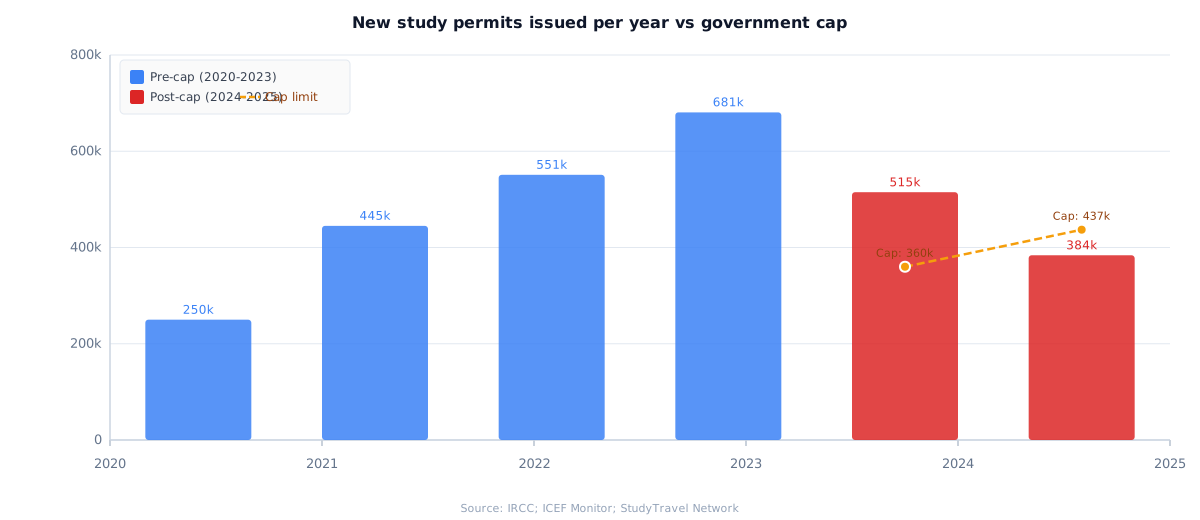
The gap between the 2024 cap target (360,000) and the actual number issued (514,915) illustrates how much momentum the system had built up. Even with a firm cap announced publicly, approvals overshot by over 40%.
Why Did the Government Intervene? Four Key Drivers
The cap did not emerge out of nowhere. Several converging pressures pushed Ottawa to act:
- Housing strain: Canadian cities ranked among the least affordable in the world. Rental vacancy rates in Toronto, Vancouver, and Calgary hit historic lows. Major bank research linked the population surge — driven significantly by international students — to acute rental market pressure.
- Compliance concerns: A 2023 IRCC audit flagged irregularities in the student visa stream, including fake Letters of Acceptance from fraudulent institutions and students who entered Canada to work informally rather than study.
- Post-graduation work permit (PGWP) bottleneck: The surge in graduates meant over 250,000 PGWP applications were pending simultaneously. Many graduates stayed as temporary workers even in occupations that were not on shortage lists.
- Public opinion: Polling showed declining public support for high immigration levels. Canada added nearly one million net new residents in 2023 — more than any other G7 country in absolute terms — generating sustained headlines about infrastructure pressure.
Work Permits: The Parallel Story
International students are just one part of Canada's temporary resident story. Work permit holders — spanning both the Temporary Foreign Worker Program (TFWP) and the International Mobility Program (IMP) — followed an even steeper growth trajectory over the same period.
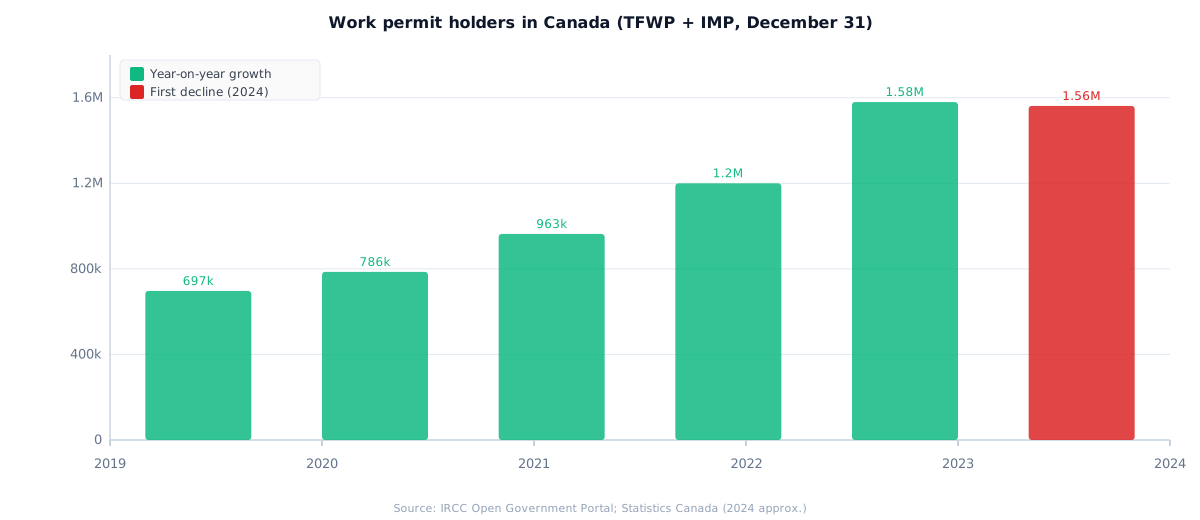
From a pre-pandemic base of ~697,000 in December 2019, work permit holders grew to ~786,000 in 2020 (many workers were exempt from border closures under essential-worker provisions). The real acceleration came post-2021. As Canada's labour market tightened — unemployment fell below 5% at points in 2022 — employers leaned heavily on the IMP and TFWP to fill gaps in agriculture, construction, hospitality, and healthcare. By December 2023, total work permit holders stood at approximately 1,580,000 — a 127% increase from 2019 in just four years. The 2024 figure of ~1,562,000 marks the first year-on-year dip: roughly 18,000 fewer holders, driven by tighter LMIA enforcement, lower PGWP issuance, and new caps on low-wage temporary positions.
Who Is Arriving? The Source Country Breakdown
The geographic story behind Canada's study permit surge is dominated by one country: India. Of the roughly 1.04 million study permit holders in December 2023, approximately 278,860 — 27% — were Indian nationals. China was a distant second at 58,430, followed by Nigeria (37,675), Philippines (33,945), and a long tail of other nationalities accounting for the remaining ~632,000. This concentration matters for policy: Indian students are especially sensitive to PGWP pathway rules, since many choose specific programs explicitly for post-graduation work rights. IRCC's November 2024 PGWP eligibility restrictions — limiting it to graduates of designated programs tied to labour market shortages — are estimated to affect hundreds of thousands of students who enrolled under now-ineligible programs.
The 2026 Outlook: A Leaner, More Selective System
The era of Canada's open-door approach to temporary residents is clearly over — at least for now. The system is shifting toward selectivity: favouring students in shortage-occupation programs, workers in high-demand sectors, and applicants with a credible path to permanent residency.
- Study permit cap continues: The 2026 cap is set at 408,000 new permits — a 7% reduction from the 2025 allocation of 437,000.
- PGWP tightening: Only graduates of programs tied to IRCC's Labour Market Impact Assessment shortage categories qualify for a post-graduation work permit.
- Work permit scrutiny: LMIA requirements are being enforced more strictly; low-wage temporary positions in specific sectors face per-employer caps.
- Provincial conditions: Some provinces are conditioning Letter of Acceptance volumes on local housing capacity data, adding a sub-national constraint on student flows.
What This Means for Your Immigration Plans
If you are a prospective international student or temporary worker, or if you are considering Canada as a destination in 2026, these trends carry concrete implications:
- Earlier planning is essential: With caps reducing total approval volumes, study permit applications need to be submitted earlier and backed by stronger supporting documents — including proof of genuine student intent.
- Program selection is now strategic: Choosing a program that qualifies for PGWP — and leads to an occupation on the shortage list — dramatically improves your chances of building a path to permanent residency after graduation.
- Work permit applicants face higher scrutiny: LMIA-based pathways now require cleaner documentation and stronger employer compliance histories than in previous years.
- Express Entry and PNP remain the end goal: Temporary status in Canada is more valuable than ever as a stepping stone to PR — but the stepping stone itself has become narrower. Maximising your CRS score during your temporary period is now critical.
ITC iLand: Navigating the New Numbers
The statistical shifts analysed above have direct, practical consequences for thousands of families who built their plans around the 2022–2023 rules. Our team of RCIC-licensed consultants tracks every policy change — whether a new cap, a PGWP eligibility update, or a change to work permit categories — so that your strategy reflects the current reality, not the 2023 one. Book a consultation today and get a clear picture of your options under the rules that actually apply now.


