

IRCC accepts three English tests and treats them identically. What decides it is where you can sit the test, and which ability is costing you CRS points.
The question people ask is "which English test is easiest?" IRCC's answer is that none of them is. It accepts three English tests for permanent residence, publishes an official conversion table for each, and gives you nothing at all for choosing one over another. A CLB 9 earned on CELPIP counts for exactly what a CLB 9 earned on IELTS counts for. The useful question is narrower: which test is easiest for you? That one has a real answer, and it turns on three things — whether you can sit the test where you live, which of the four abilities is your weakest, and how far that ability sits from the next benchmark on each test's own scale. All three are worth an hour of thought before you pay a booking fee, because none of them can be fixed afterwards.
IRCC accepts five language tests for economic permanent residence: CELPIP-General, IELTS General Training and PTE Core in English, TEF Canada and TCF Canada in French. Results must be less than two years old both when you complete your Express Entry profile and when you submit your application.
Three tests, one standard
All three English tests are converted to the same scale before anyone at IRCC looks at them: the Canadian Language Benchmarks, CLB 1 to 12. Your raw score is not what gets scored — the benchmark it converts to is, and that conversion is published by IRCC and is not negotiable. That is what "no preference" means in practice.
- CELPIP-General — built in Canada by Paragon Testing Enterprises, delivered entirely on a computer, and the only one of the three whose score is your CLB level.
- IELTS General Training — the oldest and most widely available of the three, and the only one that still puts you in a room with a human examiner for speaking.
- PTE Core — Pearson's Canada-specific test, added to IRCC's accepted list in January 2024 and marked entirely by machine.
Each of those has a near-identical sibling that IRCC does not accept: IELTS Academic, CELPIP-General LS, and PTE Academic. Booking the wrong one is one of the more expensive clerical mistakes in this process — it usually gets caught after the invitation, when there is no time left to re-sit.
TOEFL is not on the list — including the one that was "approved"
TOEFL is the test people most often arrive holding, and it is not accepted for permanent residence. Not TOEFL iBT, at any score. The genuinely confusing part is TOEFL Essentials. In August 2025 ETS announced that IRCC had added it to the list of designated language testing organizations, and much of the coverage read that as "TOEFL is now accepted for Canada". Those are two different things. ETS's own announcement still says IRCC "is not yet accepting TOEFL Essentials scores and will update its website once acceptance begins" — and as of September 2026, IRCC's Express Entry language page still lists exactly five tests, none of them a TOEFL.
A designated test is not the same as an accepted test. Book TOEFL Essentials today for a permanent residence application and you will hold a real English certificate that your Express Entry profile has nowhere to put.
What each test actually feels like
Format matters more than most people expect, because it decides which of your abilities the test is really measuring. The fees below are the Canadian prices each provider published in September 2026; international pricing differs, and all three change fees without much notice, so check the figure next to your chosen date before you pay.
- CELPIP-General — under 2 hours 50 minutes, one sitting, entirely on a computer. Listening 46–55 minutes, reading 43–56, writing 53, speaking 15 minutes into a headset. Results online in 3–4 business days. CA$299 plus tax in Canada.
- IELTS General Training — roughly 2 hours 45 minutes of listening, reading and writing, plus a separate 11–14 minute speaking interview with a real examiner. Available on paper or on computer; computer results typically arrive within a few days, paper closer to two weeks. CA$335–361 before tax in Canada, depending on the centre.
- PTE Core — a single two-hour computer test marked entirely by machine, with speaking and writing assessed together in one 50–65 minute block. Results typically in 48 hours, occasionally up to five business days. CA$360 in Canada.
The speaking section is where these genuinely differ, and it is worth being honest with yourself about it. If talking to a person makes you freeze, IELTS is the wrong test. If talking to a microphone in a room where several other people are also talking to microphones makes you freeze, CELPIP and PTE Core are the wrong ones. Speaking is one of four abilities, and under the CRS the bonuses that matter are written against your lowest one — so the ability you handle worst sets your ceiling, not your average.
Where the tests stop being interchangeable
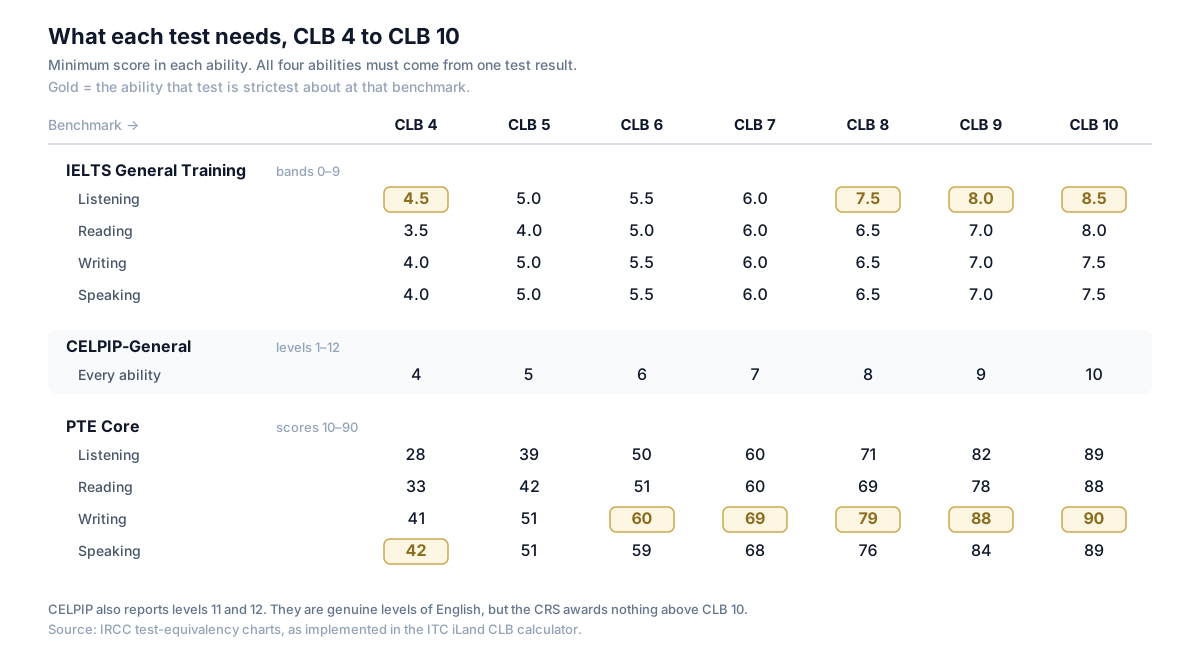
Here the choice stops being cosmetic. Each test converts to CLB on its own curve, and those curves are not evenly shaped. Find your test in the table below and read across: for every benchmark from CLB 4 to CLB 10, the minimum you need in each ability. Scores read listening / reading / writing / speaking, and CELPIP is a single number because its four thresholds are always identical.
- CLB 4 — IELTS 4.5 / 3.5 / 4.0 / 4.0 · CELPIP 4 · PTE Core 28 / 33 / 41 / 42
- CLB 5 — IELTS 5.0 / 4.0 / 5.0 / 5.0 · CELPIP 5 · PTE Core 39 / 42 / 51 / 51
- CLB 6 — IELTS 5.5 / 5.0 / 5.5 / 5.5 · CELPIP 6 · PTE Core 50 / 51 / 60 / 59
- CLB 7 — IELTS 6.0 / 6.0 / 6.0 / 6.0 · CELPIP 7 · PTE Core 60 / 60 / 69 / 68
- CLB 8 — IELTS 7.5 / 6.5 / 6.5 / 6.5 · CELPIP 8 · PTE Core 71 / 69 / 79 / 76
- CLB 9 — IELTS 8.0 / 7.0 / 7.0 / 7.0 · CELPIP 9 · PTE Core 82 / 78 / 88 / 84
- CLB 10 — IELTS 8.5 / 8.0 / 7.5 / 7.5 · CELPIP 10 · PTE Core 89 / 88 / 90 / 89
Why the lower half of the table exists: not every program asks for CLB 7. The Federal Skilled Worker Program asks CLB 7 in all four abilities, and the Canadian Experience Class asks CLB 7 for TEER 0 and 1 jobs but CLB 5 for TEER 2 and 3. The Federal Skilled Trades Program asks CLB 5 in speaking and listening and CLB 4 in reading and writing. Citizenship asks CLB 4, in speaking and listening only. The benchmark you need is set by the program you are applying under. You can convert a score you already hold — or one you are aiming at — with our CLB calculator, which uses these same IRCC tables.
The two traps in that table
Two of the three tests have one ability that is noticeably harder than the rest of the same test. Neither is obvious from the marketing, and both bite exactly at the level most candidates are aiming for.
- IELTS listening, from CLB 8 upward. At CLB 8, reading, writing and speaking all clear at band 6.5 while listening needs 7.5. At CLB 9 the other three clear at 7.0 and listening needs 8.0. A full band, every time. This is the most common way a candidate ends up with CLB 9 in three abilities and CLB 8 in the fourth — which, for the CRS bonuses that read your lowest ability, means CLB 8.
- PTE Core writing, all the way up. Writing is the strictest ability on PTE Core at every benchmark from CLB 6 upward. CLB 9 needs 88 out of 90; CLB 10 needs 90 — a perfect score. If your plan depends on CLB 10 across all four abilities, PTE Core is asking you to write flawlessly, which is a very different proposition from IELTS band 7.5.
- CELPIP is flat, and that is its real advantage. The same number in every ability, and the number is the benchmark. There is no conversion to misread, and no single ability quietly demanding more than the others.
Why CLB 9 is the number worth planning around
The CRS pays for language twice. Once directly, per ability, rising to CLB 10 — and nothing above that, which is why CELPIP 11 and 12 are real levels of English with no additional CRS value. And once indirectly, through the skill transferability bonuses, which are written as thresholds rather than sliding scales: they step up at CLB 7, step up again at CLB 9, and stop. Those thresholds read your weakest ability, so crossing from CLB 8 to CLB 9 in one skill can be worth considerably more than that single score suggests. Run that arithmetic on your own file before you decide how hard to study, not after. Our CRS calculator takes raw test scores from any of the accepted tests, so you can price a benchmark before you chase it.
Before you compare difficulty, check you can sit the test at all
This is the step almost nobody takes first, and for a good number of applicants it settles the question outright. CELPIP publishes over 200 test locations, more than 60 of them in Canada and the rest across roughly forty other countries. Pearson lists 32 PTE centres in Canada and over 500 worldwide. IELTS is the most widely available of the three. But "widely available" is not "available where you are", and two gaps matter a great deal to the people we work with.
Checked on 17 September 2026: none of the three English tests IRCC accepts appears to be bookable inside Iran, and CELPIP does not list a test centre in Vietnam. These lists change — check the provider's own centre finder for your country before you build a study plan around a particular test.
- Iran. IDP's own announcement page states that it has "made the difficult decision to stop IELTS testing in Iran", with the final test on 31 January 2026. Neither CELPIP's published location list nor Pearson's country list includes Iran. Applicants are travelling to test instead — most often to Türkiye, the UAE, Armenia or Georgia. All four appear on Pearson's country list for PTE Core; of the four, only the UAE (Dubai) appears on CELPIP's.
- Vietnam. IELTS and PTE Core are both available. Vietnam does not appear on CELPIP's published list of test locations, so the real choice there is between two tests, not three.
There is no fixing one ability later
IELTS sells a One Skill Retake: miss your target in one ability, re-sit only that one. It is a genuinely useful product, and IRCC does not accept it. IDP's own page for Canadian immigration limits acceptance to Economic Mobility Pathways Pilot candidates — not standard Express Entry, and not other permanent residence applications. So plan on the whole test. All four abilities must come from a single result: you cannot take reading from one sitting and speaking from another, or listening from CELPIP and the rest from IELTS. If one ability falls short you re-sit everything, pay the full fee again, and put the three scores you had already earned back on the table.
If this is for citizenship, take the cheaper test
If your language test is for a citizenship application rather than permanent residence, the requirement is different and much cheaper to satisfy. Applicants aged 18 to 54 must show adequate knowledge of English or French — CLB 4 or higher — in speaking and listening only. Reading and writing are not assessed at all. CELPIP sells a test built for exactly that: CELPIP-General LS, about seventy minutes, CA$199 plus tax against CA$299 for the full General test. IELTS General Training and PTE Core are also accepted for citizenship, as are several French tests. And if you completed a secondary or post-secondary program taught in English or French, that can satisfy the requirement with no test at all. Paying for a four-ability test when you need two is a common and entirely avoidable overspend.
How to actually choose
In the order that actually saves money:
- Start with availability, not difficulty. Open each provider's own centre finder for your country. If only one of the three is bookable where you are, the decision is already made.
- Name your weakest ability, then look at what each test demands of it at the benchmark you need. If listening is your weak point and you need CLB 9, IELTS is asking more of you than the other two.
- Decide how you want to speak. A human examiner, or a microphone in a shared room. There is no right answer — only the one that does not make you freeze.
- Sit a free official practice test of two of them before booking either. All three providers publish free sample material. Two hours of practice costs nothing and tells you more about your own score than any comparison article, this one included.
- Only then weigh price and speed. In Canada, CELPIP is the cheapest and returns results in 3–4 business days; PTE Core is the fastest at typically 48 hours; IELTS is the most widely available and the only one with a human examiner.
One thing not to do
If a consultant or an "agency" offers you a guaranteed score, be clear about what is being sold: someone else sitting your test. Since June 2026, IRCC officers have been required to photo-match language results against the applicant before deciding a file, and a mismatch is a misrepresentation finding — refusal, and a five-year bar on any new application. We set out how that verification works here. A retake is cheap by comparison.
The bottom line
There is no easiest test. There is a test that is easiest for you, and it is decided by geography first, by your weakest ability second, and by price a distant third. Anyone telling you one of the three is generally easier is usually selling preparation courses for it. What we would add, from the files we see: language is the one input in a CRS score that most candidates can still change. Age only moves against you, education takes years, and Canadian experience takes a job first. A single benchmark in your weakest ability is often the most reachable improvement on the table — but only if you pick the test whose curve is kindest to exactly that ability.


