
IRCC's own dashboard shows 716,600 permanent residence applications not yet finalized as of July 31, 2026 — and about a third of that backlog isn't a processing delay at all, it's the annual levels-plan cap. A stream-by-stream breakdown, in charts.

IRCC now publishes a live dashboard called "Inside IRCC's application processing system," and its Permanent residence tab is one of the more useful things the department has put online: not a downloadable data file, but a running count of how many applications are finalized, how many are still open, and — critically — why the open ones have not been decided yet. As of July 31, 2026, Canada had 716,600 permanent residence applications not yet finalized, against 305,600 finalized since the start of the year. We read the dashboard directly on September 25, 2026 and worked through every number on its Permanent residence tab below.
Where This Data Comes From, and What "Finalized" Actually Means
The dashboard lives on canada.ca under Reports and statistics, and it is refreshed periodically rather than published as a dated release — the page itself states "Data as of July 31, 2026" and was last updated September 15, 2026. There is no file to download; every figure below comes from reading the live page directly, tab by tab.
- Inside IRCC's application processing system — the source dashboard, Permanent residence tab
- IRCC's own caveat, from its "About the data" tab: "Please note that values are rounded to the closest multiple of 5. The data is approximate and subject to change."
Three things are worth being precise about before any of the numbers below. First, IRCC does not break "finalized" down by outcome on this tab — a finalized application can be an approval, a refusal, or a withdrawal, and the dashboard does not say what share is which. "Finalized" here means IRCC made a decision or closed the file, not that it was approved. Second, the department says plainly that "we're always receiving new applications, so the number of applications not yet finalized can increase" — this is a snapshot of a moving system, not a queue that only shrinks. Third, and easy to miss: IRCC attaches "since January 1, 2026" only to the finalized figures. The "not yet finalized" totals carry no such date range, so that backlog is not necessarily limited to applications filed this year — it may include files from before 2026 that are still open. Where this article compares a stream's open total to its finalized-since-January-1 total, that is a snapshot ratio, not a claim that every open file was filed this year.
Every figure in this article is IRCC's own, rounded by the department to the nearest 5 and labelled "approximate and subject to change." Percentages built on rounded figures inherit that imprecision — treat every number here as "about," even where we have not repeated the word.
716,600 Applications, Three Streams
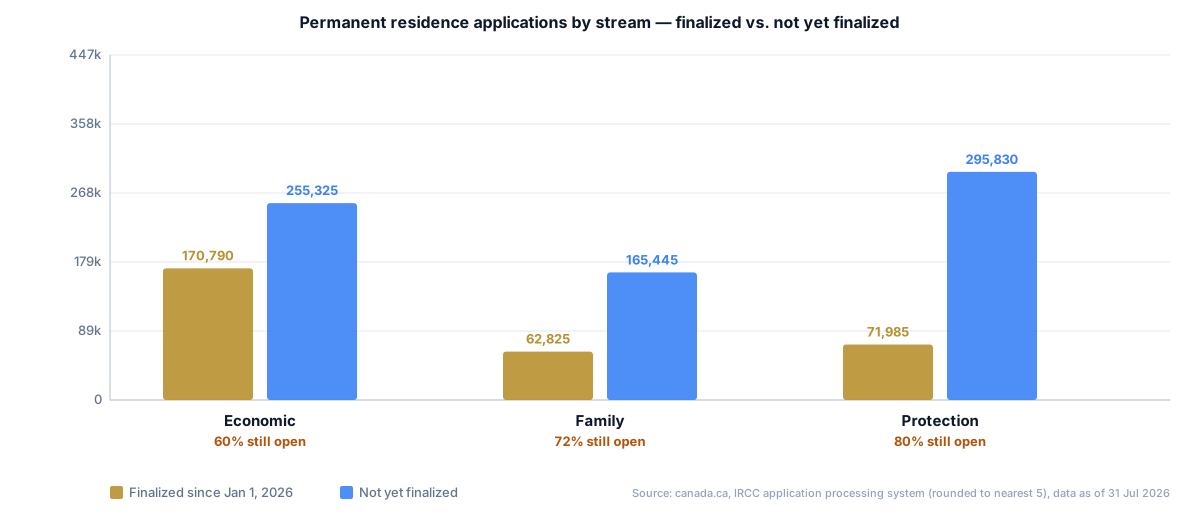
IRCC groups permanent residence applications into three streams: Economic (skills- and work-based routes, including Express Entry and the Provincial Nominee Program), Family (spousal, partner, parent, grandparent and adoption sponsorships), and Protection (asylum, protected persons, and refugee resettlement). Between them, the three streams show 305,600 applications finalized since January 1, 2026, and a further 716,600 currently sitting open — 1,022,200 applications in total across both counts.
The finalized-versus-open split looks very different once you measure the open total as a share of that combined count, rather than as a raw number. Economic has finalized the most applications in absolute terms, but its open total is large too — so 60% of Economic's combined count (finalized-since-January-1 plus currently open) is still open. Family sits at 72%. Protection is the highest of the three at 80% — its 295,830 open applications outnumber its 71,985 finalized ones by more than four to one. (As the caveat above notes, the open totals are not necessarily limited to this year's filings, so this measures a snapshot ratio, not a cohort.)
Ranked by Backlog Share, Not by Program Size
Raw counts favour whichever stream simply receives the most applications. A more useful comparison is each stream's share of the 716,600 still open, set against its share of the 305,600 already finalized:
- Protection: 41.3% of the open backlog, but only 23.6% of what's been finalized — the widest gap of the three streams
- Economic: 55.9% of what's been finalized against 35.6% of the backlog — finalizing proportionally faster than its share of what remains open would suggest
- Family: 20.6% of what's been finalized against 23.1% of the backlog — the closest to proportional of the three
Why 716,600 Files Are Still Open: Processing vs. Capacity
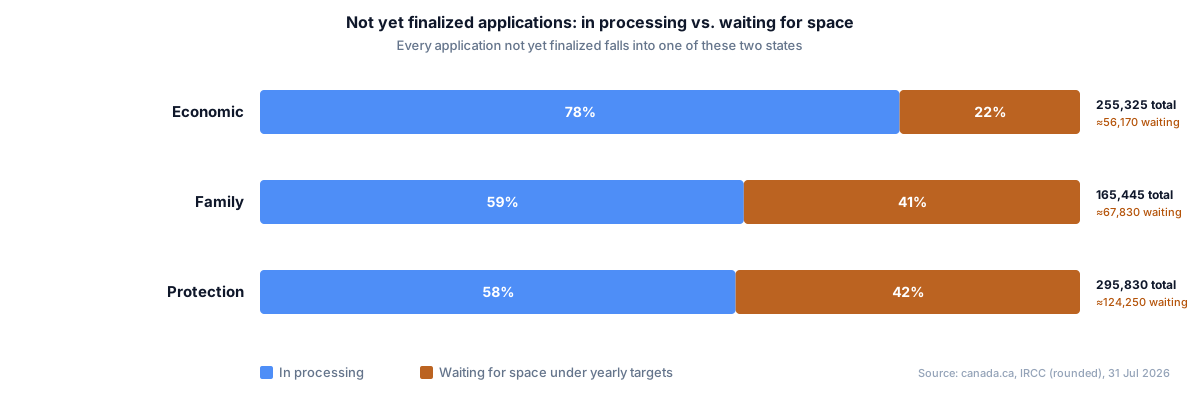
IRCC splits every open application into exactly one of two states: "in processing" or "waiting for space under yearly targets." The second state is not a processing delay in the usual sense — it means the file has cleared assessment and is ready to be finalized, but the annual Immigration Levels Plan caps how many people can be admitted in each category this year, and the file is waiting for room under that cap before it can be finalized. Across all three streams, 468,350 open applications (65.4%) are actively in processing, and 248,250 (34.6%) are waiting for space.
‘Waiting for space’ is, in one sense, better news than it sounds: it means IRCC has already finished assessing that file. It is worse news in another sense — no amount of extra documentation, follow-up, or urgency moves a file out of that state, because the constraint is the annual target itself, not the paperwork. Family and Protection carry the largest waiting-for-space shares of their own backlogs, at 41% and 42%. Economic, driven by Express Entry's faster cycle, carries the smallest at 22%.
Economic Class: Express Entry Clears Fastest, Two Programs Stay Closed
Economic is the largest stream and the fastest-moving one. IRCC's own service-standard data for Express Entry — covering the Federal Skilled Worker Program and the Canadian Experience Class, from August 2025 to July 2026 — reports that about 78% of applicants received a decision within the 6-month service standard, and about 50% received one in 5 months or less.
- Start-up Visa Program: not accepting new applications, with one narrow exception — applicants who already held a valid commitment from a designated organization in 2025 and have not yet applied. Existing applications continue to be processed, under limited capacity.
- Self-Employed Persons Program: paused indefinitely. Existing applications continue to be processed.
- In-Canada Workers Initiative: a new route transitioning up to 33,000 work permit holders already in Canada to permanent residence in 2026 and 2027 — these admissions sit outside the 2026–2028 Immigration Levels Plan targets, not counted against them.
The Start-up Visa and Self-Employed status here is IRCC's own current wording, and it matches what we have told readers before: these are not live application routes, whatever marketing elsewhere might suggest. They are legacy files being processed down, not doors open to new applicants.
Family Class: Three Programs, Three Different Clocks
Family sponsorship is not one clock. IRCC's own figures, again covering August 2025 to July 2026, put spousal, partner and dependent-child applications submitted from within or outside Canada, destined outside Quebec, at about 15 months to process.
- Parents and grandparents: demand for this program consistently exceeds the number of spaces the Levels Plan allows, so IRCC accepts a limited number of applications through set intake rounds each year. The super visa remains available as a longer-stay visitor alternative for parents and grandparents not admitted through a sponsorship round.
- International adoptions: IRCC tells families to expect at least two years, even when nothing goes wrong, because of the legal and review steps every adoption requires.
- Quebec-destined family applications run on a separate timeline, because Quebec sets its own immigration targets independently of the rest of Canada.
Protection: The Largest Backlog, and a One-Time Push to Clear It
Protection carries both the largest open-application total (295,830) and the highest share of its own workload still unfinished (80%). Two things explain why.
- Asylum claims carry no set target in the Immigration Levels Plan — IRCC has a legal obligation to assess every claim it receives for eligibility, so volume is driven by demand, not a planning figure. The department points to the Strengthening Canada's Immigration System and Borders Act as a step toward faster decisions and reduced misuse of the system as a shortcut around regular immigration pathways.
- A one-time initiative is processing up to 115,000 additional permanent residence applications from protected persons and their in-Canada dependants across 2026 and 2027 — people already legally recognized as needing Canada's protection, many of whom are already working and contributing in Canadian communities.
The size of this stream's backlog, in other words, is partly the cost of clearing it: the department is actively working through a large one-time inventory on top of its regular protected-persons and asylum caseload.
What This Means If You Have a File in the System
None of this changes any eligibility rule, and none of it predicts a decision on your specific file. What it can do is set realistic expectations:
If any of this touches a file you actually have open, the useful next step is having someone look at your dates, status and category — not extrapolating from a national average. We review files like this every week.
- "Waiting for space" is not a rejection signal, and it is not something more paperwork fixes. If your file is complete, the only thing standing between you and a decision is room under this year's target.
- If you are in Economic through Express Entry, your odds of a decision inside six months are the best of any stream — about 78% historically. Provincial and business-stream files inside Economic can move on different timelines than Express Entry itself.
- Spousal and partner sponsorship outside Quebec is currently benchmarking around 15 months. Plan travel and status-maintenance decisions around that figure, not around older ones you may have seen elsewhere.
- Parents-and-grandparents and international-adoption files run on the longest, least predictable clocks in the Family stream — a super visa is worth evaluating as a bridge if you are not selected in a sponsorship intake round.
- Do not plan around the Start-up Visa or the Self-Employed Persons Program. Both are closed to new applicants apart from a narrow 2025-commitment exception; the numbers here describe a queue emptying, not a door open.
How We Read This Data
We read IRCC's "Inside IRCC's application processing system" dashboard directly on September 25, 2026, on its Permanent residence tab, with the page itself dated "as of July 31, 2026" and last updated September 15, 2026. IRCC rounds every figure to the nearest 5 and calls the data "approximate and subject to change" — we have used "about" and "roughly" throughout for that reason, even in places we have not repeated the words. The in-processing and waiting-for-space application counts in this article are our own calculation: IRCC publishes those as percentages of each stream's open total, not as counts, so we multiplied its published percentages by its published totals and rounded to the nearest 5 to match its own convention. This is general information about how the system is functioning as a whole. It is not legal advice, and nothing here predicts the outcome or timeline of any individual application. For the admissions-side picture of 2026 so far — people actually admitted, not applications filed — see our H1 2026 immigration statistics analysis, drawn from a different IRCC data source and measuring a different six-month window.
Talk to a Licensed Consultant About Your Own File
A dashboard describes a system. It cannot tell you whether your sponsorship will clear the levels-plan cap this year, whether your Express Entry profile is competitive at current cut-offs, or which stream actually fits your situation. ITC iLand is led by Ramin Asadi, a Regulated Canadian Immigration Consultant (CICC No. R407111), and we read every IRCC data release so that the advice we give reflects how the system is actually operating today.


