
IRCC's own dashboard shows 394,325 temporary residence applications not yet finalized as of July 31, 2026 — visitor visas alone are 83% of the entire system, but study permits carry the highest still-open share of any category. A category-by-category breakdown, in charts.

We recently looked at the Permanent residence tab of IRCC's "Inside IRCC's application processing system" dashboard. Its Temporary residence tab covers a different, much larger world: study permits, work permits, and visitor visas — new applications only, not extensions. As of July 31, 2026, Canada had 394,325 temporary residence applications not yet finalized, against 1,832,065 finalized since the start of the year. We read the dashboard directly on September 25, 2026 and worked through every number on its Temporary residence tab below.
Where This Data Comes From
Same dashboard as our permanent residence analysis, different tab. The page states "Data as of July 31, 2026" and was last updated September 15, 2026. There is no file to download; every figure below comes from reading the live page directly.
- Inside IRCC's application processing system — the source dashboard, Temporary residence tab
- IRCC's own caveat, from its "About the data" tab: "Please note that values are rounded to the closest multiple of 5. The data is approximate and subject to change."
The same precision points from our permanent residence article apply here. "Finalized" means IRCC made a decision or closed the file — the dashboard does not say what share were approvals versus refusals versus withdrawals. IRCC attaches "since January 1, 2026" only to the finalized figures, not to the "not yet finalized" totals, so the open totals below are not necessarily limited to applications filed this year. And unlike the Permanent residence tab, this tab does not publish any breakdown of why an application is still open — there is no "in processing" versus "waiting for space" split here, because that framing does not fit: visitor visas carry no annual target at all.
Every figure in this article is IRCC's own, rounded by the department to the nearest 5 and labelled "approximate and subject to change." Treat every number here as "about," even where we have not repeated the word.
394,325 Applications, Three Categories
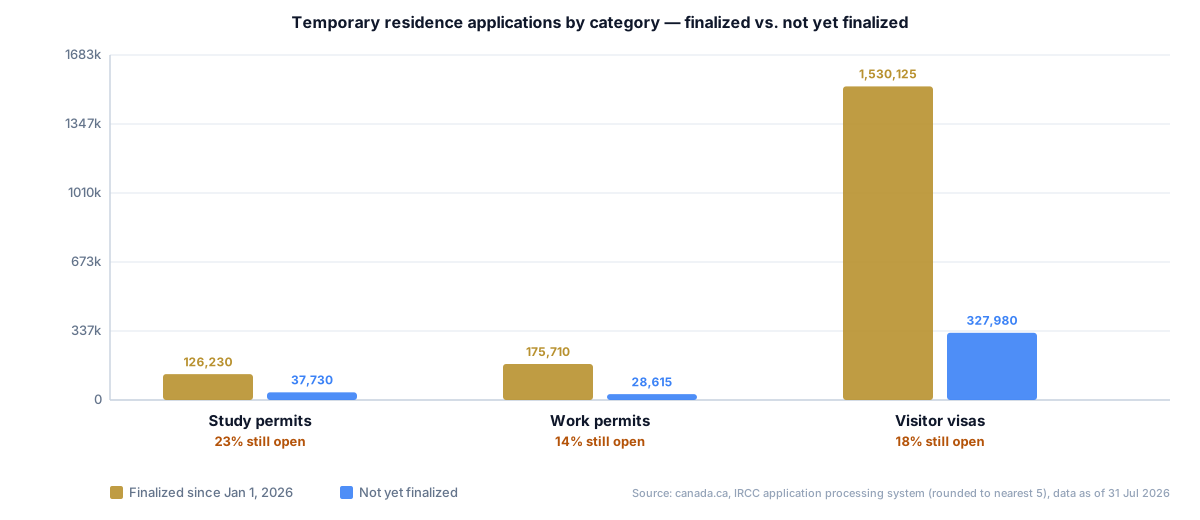
IRCC groups new temporary residence applications into three categories: study permits, work permits, and visitor visas. Between them they show 1,832,065 applications finalized since January 1, 2026, and a further 394,325 currently open — 2,226,390 applications in total across both counts. These three categories sum exactly to the tab's own totals, so nothing is left uncategorized.
The categories are wildly different sizes. Visitor visas alone account for 83.5% of everything on this tab — 1,858,105 of the 2,226,390 total applications, finalized and open combined. Work permits are the next largest at 9.2%, and study permits are the smallest at 7.4%, despite being the category most people associate with Canadian immigration planning.
Ranked by Backlog Share, Not by Volume
Comparing each category's share of the 394,325 still open against its share of overall volume shows which categories are over- or under-represented in the backlog:
- Study permits: 7.4% of total volume, but 9.6% of the open backlog — over-represented, consistent with the highest pending ratio of the three (below)
- Work permits: 9.2% of total volume, but only 7.3% of the open backlog — under-represented, clearing proportionally faster
- Visitor visas: 83.5% of total volume and 83.2% of the open backlog — almost exactly proportional; at this scale, visitor visas effectively set the system average
Study Permits Are the Smallest Category — and the Slowest, Proportionally
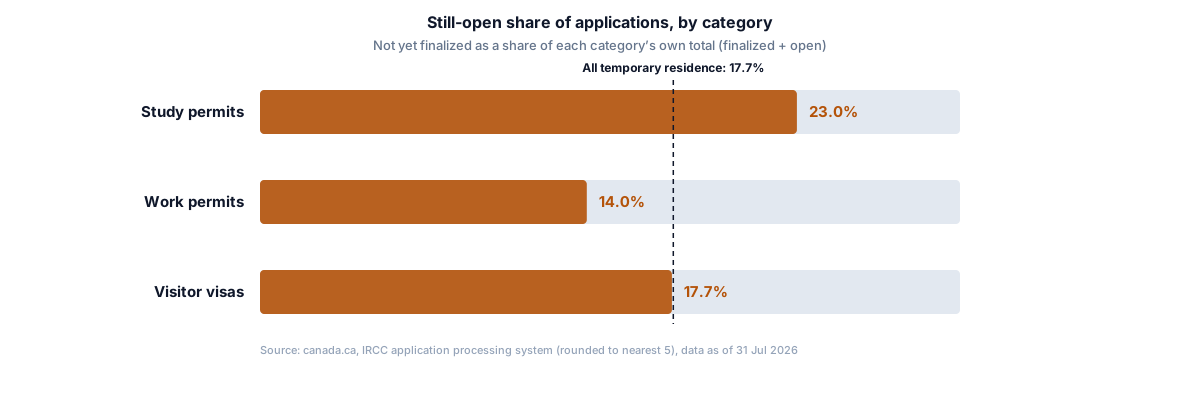
Measured as a share of each category's own total (finalized plus open), study permits have the highest still-open share of the three at 23.0% — despite being the smallest category by volume. Work permits have the lowest at 14.0%. Visitor visas sit at 17.7%, matching the all-categories average of 17.7% almost exactly, because visitor visas are most of what that average is built from.
Study Permits: Seasonal Demand, and a Fast Track for PhD Applicants
IRCC notes that "most international students start school in the fall or winter, so the number of applications we receive goes up and down during the year" — which is one reason a snapshot ratio like the one above moves depending on when in the year you check it. The department's standing advice is to apply as soon as you are accepted to a designated learning institution, so processing can finish before classes start.
- As part of Canada's International Talent Attraction Strategy, IRCC has launched 2-week processing for study permit applicants applying at the PhD level specifically — this does not extend to other study levels.
Work Permits: Global Skills Strategy, Quebec Measures, and a Fast Track for Doctors
Work permits carry the lowest still-open share of the three categories, and IRCC names several deliberate fast-track mechanisms that likely contribute to that:
- The Global Skills Strategy processes eligible employer and skilled-worker applications faster, to help fill jobs where Canadian workers are not available or to meet economic priorities.
- Special measures for Quebec allow certain workers to continue working in the province, to help prevent labour shortages there.
- A dedicated 14-day processing track exists for up to 5,000 licensed doctors with job offers who have been nominated through the Provincial Nominee Program — letting them work in Canada while their permanent residence application is still in progress, rather than waiting for PR to be finalized first.
Visitor Visas: No Arrival Target, and Most of the System
Visitor visas are unique among the three categories: the Immigration Levels Plan sets no arrival target for them at all. IRCC is explicit about why — "to support tourism and the economy, there is no arrival target set for visitor visas." Processing time instead depends on:
- whether the application is complete
- how quickly biometrics and required documents are provided
- whether extra security screening is needed
- how many applications IRCC receives from a given country at a given time
What This Means If You Have an Application in the System
None of this changes any eligibility rule, and none of it predicts a decision on your specific file. What it can do is set realistic expectations:
If any of this touches a file you actually have open, the useful next step is having someone look at your dates, status and category — not extrapolating from a national average. We review files like this every week.
- This tab does not explain why your application is still open. Unlike the Permanent residence tab, there is no published "waiting for capacity" state here — an open temporary residence file could simply still be in the processing queue, waiting on your documents, or flagged for extra screening, and this data cannot tell you which.
- If you are applying for a study permit for a fall or winter start, apply the moment you are accepted. Application volume is seasonal, and the queue you enter depends on when in the year you file.
- PhD applicants specifically have a 2-week service target — worth confirming you qualify for it before assuming a longer timeline.
- If your work permit depends on the Global Skills Strategy, Quebec's special measures, or a PNP-nominated physician job offer, faster tracks exist — confirm whether your specific case qualifies rather than assuming the general timeline applies.
- Visitor visa timing varies most by application completeness and by your country of application — there is no fixed target to benchmark against, so build in more schedule flexibility than for study or work permits.
How We Read This Data
We read IRCC's "Inside IRCC's application processing system" dashboard directly on September 25, 2026, on its Temporary residence tab, with the page itself dated "as of July 31, 2026" and last updated September 15, 2026. IRCC rounds every figure to the nearest 5 and calls the data "approximate and subject to change" — we have used "about" and "roughly" throughout for that reason, even in places we have not repeated the words. This is general information about how the system is functioning as a whole. It is not legal advice, and nothing here predicts the outcome or timeline of any individual application. For the companion analysis of the same dashboard's Permanent residence tab, see Canada's PR Backlog Hits 716,600. For the admissions-side picture of 2026 so far, see our H1 2026 immigration statistics analysis, drawn from a different IRCC data source and measuring a different six-month window.
Talk to a Licensed Consultant About Your Own File
A dashboard describes a system. It cannot tell you whether your study permit will clear before your program starts, whether your work permit qualifies for a faster track, or how your visitor visa compares to others from your country. ITC iLand is led by Ramin Asadi, a Regulated Canadian Immigration Consultant (CICC No. R407111), and we read every IRCC data release so that the advice we give reflects how the system is actually operating today.


